


On October 3, 1995, prolific football star and actor O.J. Simpson was found not guilty of the murders of Nicole Brown Simpson and Ronald Goldman in a criminal trial. The country was shocked – there appeared to be a myriad of evidence pointing to Simpson as the clear culprit. However, there was one particular piece of evidence that kept the jury from convicting Simpson – the glove tied to the crime scene did not fit on his hand. But why would the fact that the glove did not fit mean that the jury must acquit?
Even more confusion ensued when, less than two years later, a different jury found Simpson liable for the deaths of Nicole Brown Simpson and Ronald Goldman in a civil trial. The glove was still a relevant piece of evidence, but it was all but the central concern of the argument for either plaintiff’s or defendant’s counsel. Of course, more evidence had come up in the time following the failed conviction of Simpson, but if it was so crucial to the defense’s strategy in criminal court, then why did it not hold the same weight in a civil court?
The short answer: There are different standards of proof between criminal and civil trials to determine whether someone is guilty, not guilty, liable, or not liable. It’s essential to understand what a “standard of proof” means in legal proceedings, why those standards of proof differ in various settings, and how attorneys will strategize in the face of those different standards.
What is a standard of proof?
A “standard of proof” is the degree or level of proof demanded in a specific case. It is also a rule about the quality of evidence that a party must bring forth to prevail. Attorneys often refer to meeting the required standard of proof as a burden a party must bear to succeed in their argument. If an attorney does not fulfill their burden to prove their case under the relevant standard of proof, then they lose their argument. What that burden looks like changes based on the courtroom and the proceeding.
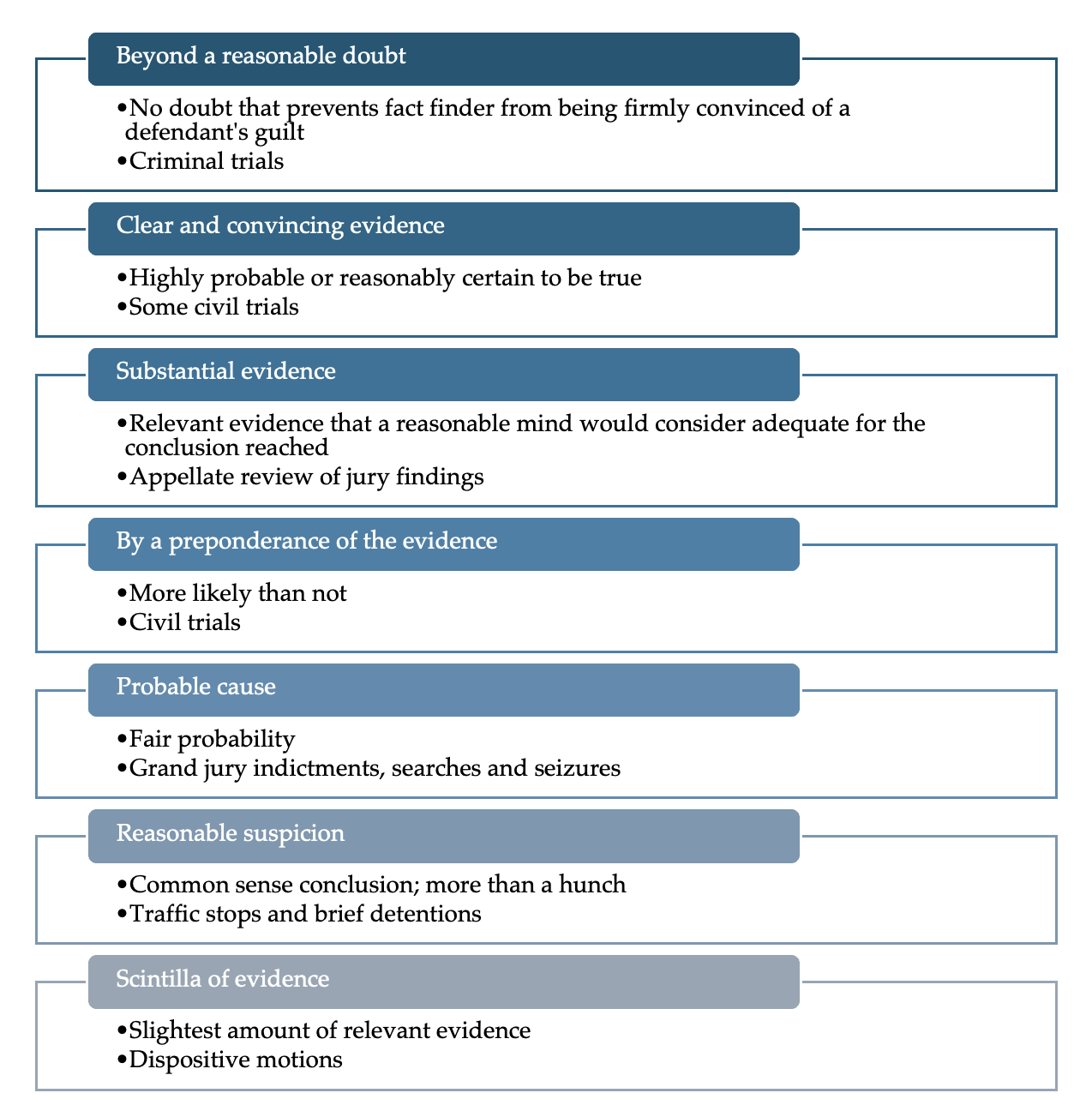
Below is a quick graphic of the common standards of proof used in legal proceedings, ranging from the highest burden of “beyond a reasonable doubt” to the lowest burden of “scintilla of evidence.” We will discuss each burden and explain why certain standards apply differently in certain contexts.
Beyond a reasonable doubt.
In a criminal trial, the prosecutor must prove their case against a defendant beyond a reasonable doubt. The United States criminal system affords indicted criminals a presumption of innocence. This means that, unlike in civil trials, the jury is instructed to presume that a person charged with a crime is innocent unless and until the prosecution supplies sufficient evidence to rebut that presumption beyond a reasonable doubt. If any doubt prevents a fact finder from being firmly convinced that a defendant is guilty of the crime they are being charged with, then the prosecution has failed to meet its burden to prove its case, and the jury must find the defendant not guilty.
The glove in O.J. Simpson’s case planted and watered that seed of doubt in the jury’s mind that prevented them from finding him guilty. The jury heard thorough testimony that whoever killed Nicole and Ronald wore that glove when they did it. However, they also watched as Simpson attempted to put the glove on but could not because it was too small. In the vacuum that the court system places jurors in to give each party their fairest shot, it is understandable that they would be less than firmly convinced of Simpson’s guilt.
Clear and convincing evidence
In specific settings for civil trials, an attorney must prove their case using clear and convincing evidence. This standard is not quite as high as beyond a reasonable doubt, but it is still a heavier burden than proving something by a preponderance of the evidence. To prove something by clear and convincing evidence means that the thing to be proved is highly probable or reasonably certain to be true.
Civil courts increase the standard of proof in cases where the allegations include causes of action like fraud. By merely alleging fraud, ripple effects outside the courtroom for the accused party are more likely. By requiring the accuser to prove their case by clear and convincing evidence, rather than by a preponderance of the evidence like most other civil cases, parties are dissuaded from filing frivolous lawsuits for more devastating accusations.
Substantial evidence
Substantial evidence is a standard applied to a jury’s decision in the appeals process. An appellate court will uphold the jury’s verdict if it is supported by substantial evidence. In other words, if there is relevant evidence such that a reasonable mind would consider the evidence adequate to support the conclusion reached, the appellate court will uphold the jury’s finding.
By a preponderance of the evidence
In a standard civil trial, a plaintiff’s attorney must prove their client’s case by a preponderance of the evidence. Simply put, it must be more likely than not that the plaintiff’s argument is true for the fact finder to side with the plaintiff. A jury is often instructed that if they believe the plaintiff more than the defendant, even if that difference is slight, then they must find for the plaintiff.
This is why the jury in Simpson’s civil trial could easily find for the plaintiff despite the evidence of the glove. Maybe the glove didn’t fit, which could create reasonable doubt in a juror. However, the question was no longer about reasonable doubt – the jury instead was asked to consider whether it was more likely than not that Simpson was responsible for their deaths. This is a much lower burden for the attorney to carry and hold Simpson liable.
It also explains why the glove was not heralded as a cornerstone piece of evidence for the defense in the civil trial, unlike the criminal trial. The glove may have been strong enough on its own to create reasonable doubt, but in the sea of the rest of the evidence incriminating Simpson, it was not enough to tip the scales in his favor by a preponderance of the evidence. While the defense adjusted to the new burden of proof, it was clear that the jury found the overall evidence supporting liability for murder convincing enough to hold Simpson liable in a civil trial.
Probable cause
Most people hear about probable cause in the context of police investigations, but it is also relevant in grand jury proceedings. Probable cause is a standard of proof born from centuries of precedent interpreting the Fourth Amendment of the U.S. Constitution and what evidence police must have to support a search or seizure, either by obtaining a warrant or through some exception allowing for the search or seizure to take place without a warrant. At its core, probable cause is the practical common-sense decision whether, given all the circumstances, including the veracity and basis of the knowledge of persons supplying hearsay information, there is a fair probability that a crime took place.
Probable cause serves as the standard of proof that a grand jury must use to indict a suspect of a crime before commencing a criminal trial to convict that suspect. Prosecutors use grand jury proceedings to support their decision to move forward with their case against a suspect because if a jury sees the evidence and cannot agree that it is fairly probable that the alleged crime was committed, then the chance that the prosecution could meet the higher standard of beyond a reasonable doubt to convict the suspect is so low that the charges would likely be dropped. It saves time, resources, and unnecessary suffering for the suspect.
Reasonable suspicion
Reasonable suspicion is the standard of proof police must have to commence a traffic stop or brief detention of an individual. It is a lower standard than probable cause but must be more than a mere hunch or speculation. A reasonable suspicion must come from a common-sense conclusion of a reasonable person to be suspicious that a crime is taking place. This standard is rarely discussed in court proceedings, but it comes up when determining whether an officer properly conducted their investigation of a crime.
Scintilla of evidence
Parties often file motions to dispose of the case, including motions for summary judgment or directed verdict. These motions are only granted if there are no issues of material fact to be determined by a jury, and only issues of law that a judge can resolve. However, the court cannot grant a dispositive motion if there is even a scintilla of evidence, or even the slightest amount of relevant evidence, to support the nonmovant’s position. This is the lowest burden required to support a case moving forward, which is why it comes up so rarely.
Standards of proof sit at the core of the judicial process. The differences between each standard will make or break a case, as is evident in the different outcomes in the cases involving O.J. Simpson. However, identifying when each standard applies helps the general public understand lawyers’ approaches to each case, motion, and argument to best help their clients succeed.
Written by:
Kenadie Wilde
Law Clerk
GUERRA LLP
875 East Ashby Place, Suite 1200
San Antonio, Texas 78212
Phone: (210) 447-0500
Frank Guerra
Board Certified – Personal Injury Law
Texas Board of Legal Specialization
GUERRA LLP
875 East Ashby Place, Suite 1200
San Antonio, Texas 78212
Phone: (210) 447-0500
Be sure to follow us on Instagram and Facebook to see more Guerra LLP news!