

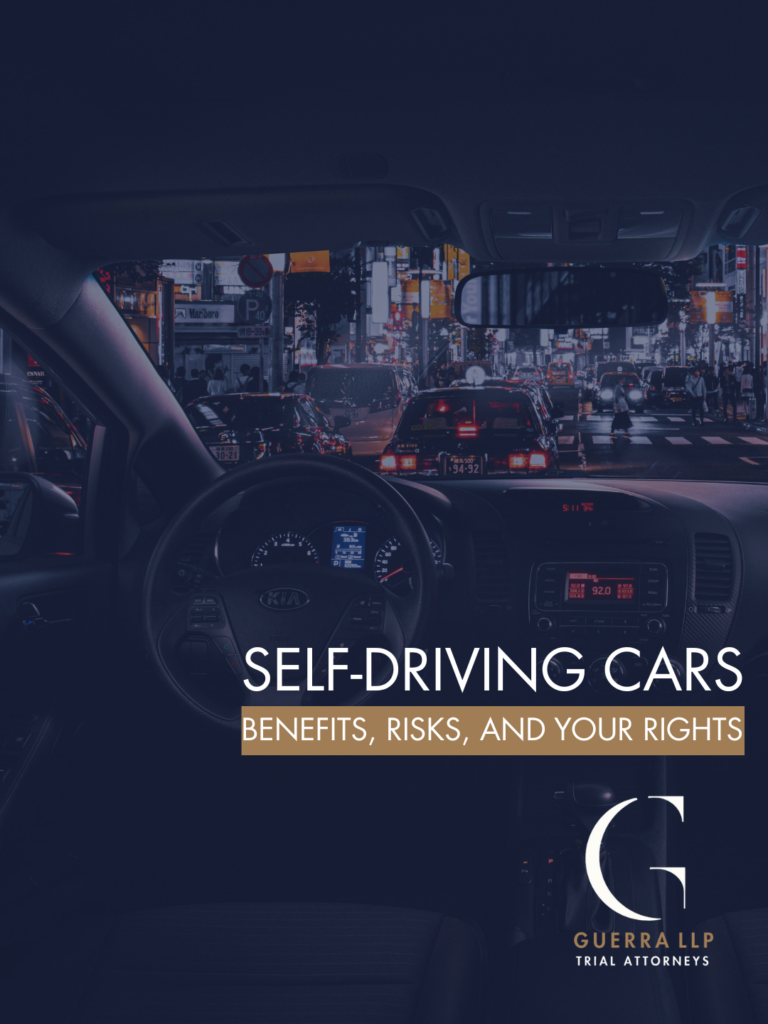
On December 9th, 2025, Mr. Chris Riotta-Rogers of San Francisco, California, went viral on TikTok for his “first and last Waymo ride.” The 20-second-long clip, amassing nearly 28 million views, captured Mr. Riotta-Rogers commencing a ride in a Waymo, a driverless car, which, in the tumultuous moment that followed, abruptly pulled out in front of another moving car traveling down a steep hill. The other car honked and slammed to a halt, inches from the Waymo, as the shaken Waymo passenger sat helplessly in the back seat.[1]
If the virality of videos such as Mr. Riotta-Rogers’ indicates anything about the public sentiment surrounding driverless cars, it is certainly one of distrust and skepticism. Indeed, according to a 2025 survey by AAA, 61% of drivers expressed fear of riding in a self-driving vehicle, with only 13% expressing trust.[2] And this is for good reason. In October 2025, the National Highway Traffic Safety Administration launched a probe into 2.8 million vehicles using Tesla’s self-driving technology due to a consistent pattern of traffic violations and accidents.[3] Further, in December 2025, Waymo issued a recall of over 3,000 vehicles after their self-driving software consistently put children’s lives at risk by passing stopped school buses.[4] Beyond just that, self-driving cars have been seen violating even the most basic traffic laws. For a particular instance, a video from Austin, Texas, posted to Reddit on December 12th, 2025, shows a driverless car traveling wrong-way down a busy one-way frontage road.[5] Certainly, the distrust is well-substantiated.
Though once squarely in the realm of science fiction, self-driving cars have become a common sight on San Antonio roads in recent months, as well as in other major cities across Texas and the United States. With the advent of this new technology comes a torrent of immediate yet complicated legal questions – the most relevant of which to many of our clients is “what should I do if I get into an accident with a self-driving car?” To be sure, the process here is much different from that in the event of an ordinary car accident. Toward this end, we implore caution with regard to this incipient technology and outline the steps we recommend should you be involved in an accident with a self-driving car.
Weighing the Benefits and Risks
Granted, the turn to self-driving cars shows great potential. There is promise for this technology to one day eradicate the risks of impaired and distracted driving. Proponents, moreover, adamantly stress that self-driving car collisions are less frequent than regular collisions and, among the collisions that do occur, self-driving cars are rarely at fault.[6] Historical precedent backs this potential as well. Less than two decades ago, now-widespread ridesharing services, such as Uber and Lyft, faced similar setbacks and mixed feedback in their own early days due to risks and unknowns before attaining broader public acceptance.
That said, the unknowns loom large while self-driving technology remains incipient. For instance, Waymo’s data on self-driving cars is lacking outside a few specific regions. Indeed, as Waymo’s Safety webpage acknowledges, their crash-reduction statistics rely on data solely from their “operating cities.”[7] Tesla, too, draws their statistics only from a large yet self-selected sample of Tesla owners.[8] The safety data from the two leading manufacturers of self-driving technology, however impressive, does not change the fact that a more holistic look at self-driving car safety has yet to come to fruition.
In the meantime, much like it is unwise to predict the actions of human drivers on the road, it is best to exercise equivalent caution around self-driving vehicles. As Waymo’s co-CEO, Tekedra Mawakana, said in October 2025, “we don’t say ‘whether’ [a Waymo will kill someone]. We say ‘when.’”[9] Ironically, Waymo’s competitor, Tesla, had been hit by a $243 million jury verdict just two months prior to this statement in August of 2025, following a fatal crash lawsuit involving Tesla’s Autopilot feature.[10]
What to do Following an Accident with a Self-Driving Car
Despite the risks and unknowns, self-driving cars are here to stay. In November 2025, Waymo announced plans for its self-driving vehicles to become fully operative on Dallas, Houston, and San Antonio, Texas roads in the near future.[11] And, in early 2026, a Tesla owner allowed his vehicle to complete a fully autonomous 2700-mile drive from Los Angeles, California, to Myrtle Beach, South Carolina.[12] As such, it is essential for all drivers to be prepared legally. That is, knowing what to do in the event of an accident with a self-driving car is a must for protecting yourself.
- If you get into an accident with a self-driving car, the most crucial step is to first call 911.
- This takes precedence over all else, especially after a serious accident and/or if you are injured.
- Second, document everything. That is, take an abundance of pictures of both your vehicle and the self-driving vehicle.
- These pictures should include several close-up and zoomed-out pictures of the damage to identify the extent of the damage, the vehicle types, road conditions, road signs, resultant debris, and any lights and/or messages coming from inside or outside the self-driving vehicle.
- Third, contact an attorney – specifically, an attorney specializing in personal injury and/or product liability.
- In the event of accidents with self-driving cars, proving that you weren’t at fault becomes more complicated as insurance companies’ focus often shifts to what you, the human, could have avoided, as opposed to what the self-driving car may have done wrong. Moreover, the most important question often becomes liability: is the product manufacturer, self-driving software developer, or car owner responsible? For these reasons, among others, having an attorney experienced in both personal injury and product liability fighting on your behalf is paramount to maximizing your recovery following a self-driving car accident.
Ultimately speaking, the takeaway is that self-driving cars warrant great caution. Though we should be slow to vilify them, the unprecedented challenges self-driving cars pose requires drivers not only be more informed than ever but to be diligent in seeking legal representation in the event of an accident. To be sure, self-driving cars are here to stay: the risks, the benefits, and everything in between. It is up to all of us to be cautious, prudent, and wise in all our dealings with this uncharted technology.
Written by:
James Dowell
Law Clerk
GUERRA LLP
875 East Ashby Place, Suite 1200
San Antonio, Texas 78212
Phone: (210) 447-0500
Frank Guerra
Board Certified – Personal Injury Law
Texas Board of Legal Specialization
GUERRA LLP
875 East Ashby Place, Suite 1200
San Antonio, Texas 78212
Phone: (210) 447-0500
Be sure to follow us on Instagram and Facebook to see more Guerra LLP news!