

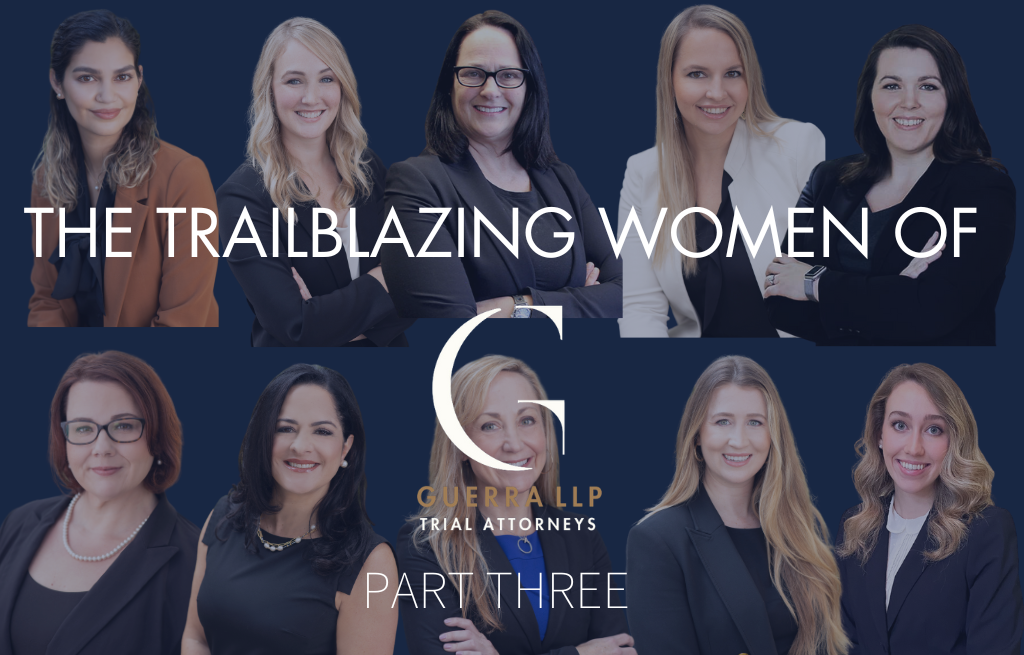
In case you haven’t quite noticed, we love bragging about our staff here at Watts Guerra, especially our women during Women’s History Month every March. One of our yearly traditions is to ask our female attorneys questions about their unique experiences in this profession. They provide us with wisdom and advice based on what they have encountered, and we turn it into an article which is one of our most-read items on our website each year.
In 2024 our law firm underwent a collaborative and strategic restructuring, and we have now become Guerra LLP! So, while this post applied to our previous namesake, some things will never change, like our unrelenting work ethic. With decades of experience on our staff that you are familiar with, our team is remaining steadfast in our mission to continue to fight the good fight for our current and future clients.
Check out our previous blogs on our Female Trial Lawyers here.
This year we asked our attorneys questions ranging from who they try to emulate in their practice to if they always had the dream of being an attorney, and how they navigate a male-dominated field. We also asked them about being inclusive and supportive of one another. Uniformly, all of our female attorneys advocate for each other and others in their field. They “invite them to the table,” as attorney Alicia O’Neill sums up, and always make a point to support one another.
“There’s a special place in hell for women who don’t help other women.” – Madeleine Albright
This quote is attorney Shalimar Wallis’s favorite quotes. However even with this supportive culture that our attorneys are trying to nurture, they still experience some biases they have to battle in the courtroom such as,
“I’ve had men ask me to fetch their coffee for them, call me ‘sweetie’ or ‘honey’, and make unnecessary comments about my appearance.”
“Different members of the court staff asked me to step behind the bar because they assumed I was not a lawyer.”
“I have been mistaken for a court reporter or paralegal many times.”
At the end of the day, they do not let it affect them and they prove to be stronger than ever fighting for their clients. So, check out this year’s candid article detailing their experience in the legal industry by our strong, powerhouse, female trial attorneys who are paving the way for current and future generations.
How do you balance your personal and professional life?
Being an attorney is more than a Monday through Friday, 9am to 5pm job, and finding the balance of getting work done without it impeding on personal lives is a constant struggle. Our attorneys all agree that some days or weeks are easier to juggle than others and that you have to carve out time for things outside of work that help promote self-care.
Attorneys Shalimar Wallis, Erin Rogiers, and Alicia O’Neill are all mothers and make sure to set aside time for their children. Alicia is a mom to a 12-year-old who used to come to work with her every weekend when he was younger and color while she worked. Now that he is older, she has prioritized her time to try only work on weekends before he wakes up if at all possible (a piece of advice that she stole from Capital Partner, Frank Guerra). She also makes it a point to have one on one time during the week. They have a standing Wednesday night dinner reservation that they uphold each week, no matter what is going on.
Other female attorneys like Meredith Drukker Stratigopoulos, Jennifer Neal, and Rebecca Page all make sure to practice self-care outside of work to help their lives maintain a proper balance of work and personal time. Rebecca makes sure that she has a healthy sports outlet, so she plays flag football a couple of times during the week. This commitment helps her not work late on those nights and forces her to set aside time to do something that she loves. Meredith has learned over the years to treat her personal commitments like work commitments by placing them on her calendar as she does with her work events. “I didn’t try to balance for my first three years of practice and simply made personal sacrifices to prioritize my professional life. This year I have sought to protect my time outside of work. In my life, this means a no-excuses gym routine, vacations (without checking my email) with my husband, reading books for pleasure, and spending time with my family (not on my email).”
What steps do you take to prep for a difficult case or what is your routine to prep?
Our attorneys had several pieces of advice that have been found to have served them well during their court proceedings. For all, they like to be organized from the get-go. “Make a checklist and proposed timeline. Anticipate the steps of the case and the resources you need so you can get ahead of the ball,” Jennifer advised. Rebecca went on to discuss how she likes to familiarize herself with the discovery and experts. With the experts, she likes to also familiarize herself with their publications so she can potentially use them to her advantage during questioning. Meredith not only relies on preparation, practicing oral arguments, and advice from mentors, but also heavily leans into her routine. Her day-to-day habits of exercise and nutrition help guide her through tough work seasons.
“Begin preparing well in advance and never underestimate your opponent” is advice Shalimar, who has been practicing law for over 21 years, provided. She went on to say, “Preparation and organization will make you confident regardless of the difficulty of the case, deposition, hearing, trial, etc. But all the preparation in the world won’t help if you underestimate your opponent.” Alicia, an attorney for almost 20 years, emphasized preparation as well stating, “I work my ass off and learn every single thing about the case so that there is nothing that can surprise me or rattle me. I’d like to say that it gets easier over the decades or that it comes easily to me – but it does not and never has. Nothing can replace putting in the work.”
When you were younger, did you ever imagine you would find yourself in this sort of career? Were there people in your life that tried to dissuade you from this career path?
For Shalimar and Meredith, they knew that they were going to be lawyers from early on in their life. Meredith had two female lawyer mentors that helped pave the way for her and inspired her to achieve her dream. For the others, they realized it further down the road. Jennifer began her journey when she was thirty, Rebecca wanted to be a veterinarian and then a forensic pathologist before she changed her mind when she received her undergraduate degree, and Alicia’s father told her she would make a great attorney before she even knew she wanted to be one.
While some attorneys had mentors and support systems along the way, others received dissuasion from peers. For Rebecca, it was because of the “hefty student loan bill,” that she would end up with. For Alicia, her peers told her that she would have a hard time as a woman making it as a trial lawyer, but they were obviously very wrong.
What woman in history (dead or alive) do you try to emulate?
For Erin, it’s Michelle Obama and for Jennifer, it is the late Ruth Bader Ginsburg. Shalimar looks to Margaret Thatcher and Madeleine Albright while Meredith has her mentors from her childhood (Leslie Moeller and Debbie Ledoux) along with Ann Richards and Condoleezza Rice. Alicia doesn’t try to emulate anyone solely because she believes jurors look for authenticity and she feels like she should just be herself. That being said, she admires the women who blazed the trail before her whether they be Supreme Court Justices, activists, poets, or her mom who studied to get her nursing degree in the late hours of the night while she was growing up. Alicia sums it up perfectly when she said, “there is power in being a woman and there are endless examples of that in this world.”
How do you network in a male-dominated field such as law?
In the legal community, a component of your success is networking with those around you. Local organizations like Bar Associations and legal networks help you to familiarize yourself with other lawyers in your area. In San Antonio, we have organizations like SATLA, SAYLA, and TTLA that our female attorneys recommend becoming members of. Rebecca also recommended attending CLE classes. “By showing up, you get to recognize familiar faces and eventually create relationships.”

How have you seen attitudes towards women in law change over your years of practice?
For those attorneys who have been practicing a longer amount of time, like Shalimar and Alicia, they have seen gradual changes over the years. “I think the thing that I have noticed the most is how great young female litigators are standing up for themselves and refusing to allow other people to treat them differently because of gender. The time for sexism has passed and I love watching my young partners prove it every day,” Alicia said. Shalimar appreciates the progression of law and how the archaic law of “face time” is dissipating. “Instead of lauding hours at the office, we laud efficiency and productivity in creative ways to allow us to at least feel as if we are coming closer to achieving a work-life balance that we can live with,” she explained.
Meredith loves witnessing more and more women in MDLs and on MDL leadership (Watts Guerra has four powerhouse women in MDL Leadership) because “when women are being looked to as leaders, experts, and fighters in the field, it means that the underlying attitudes are changing as well.” Firms that promote, train, and grow a strong culture that supports women and allows them flexibility, just as Mikal and Frank do, explained Alicia, helps change the status quo in the field.
Times are changing and female attorneys, like our Watts Guerra women, are making huge impacts in the legal industry. “I think we are at a point in time where women have excelled at this career, and it’s quite normal to see just as many women in a courtroom as men. In fact, the Bexar County District Courts have 11 incredible female judges, and the 4th Court of Appeals is comprised of ONLY women,” Rebecca confirmed. Our attorneys know that they are where they are today due to the many women who have paved the way before them, and Meredith believes that the future of this field is her generations for the taking. Jennifer advises that this profession can still be a “boys club”, but Shalimar emphasizes that, “just because something has always been done in a certain manner doesn’t mean that it needs to continue that way in perpetuity.” Our female attorneys are making changes every day and we are fortunate enough to have a front-row ticket witnessing it.